I'm James Gonzo. I run James Gonzo Fitness in Heywood, helping beginners get moving. If you're about to start Couch to 5K, you'll have seen running shoes at well over £100. Good news: you don't need to spend that. Here's how to choose your first pair, and three shoes under £80 with their prices checked on 31 October 2026.
Quick answer: Pick comfortable, supportive running shoes that fit well, with a little room for your toes. You don't need a pricey pair to start. Try them on with your running socks, make sure you can return them, and spend more later if you stick with it.
Do you need running shoes to start?
Yes, but not expensive ones. The NHS Couch to 5K plan says to wear comfortable clothes "along with running shoes that support your feet". That's the NHS wording, and it doesn't say anything about price.
Sports scientist Dr Greg Whyte told BBC Sport: "Sadly, we've been indoctrinated in this idea that the more it costs, the better it is." He added that you don't need "very good trainers" to start, because "much of it is walking initially" and you don't need expensive trainers to walk.
Dr Whyte's advice is to start the programme before you invest. Once you know it's for you, he says, spending money is more worthwhile.
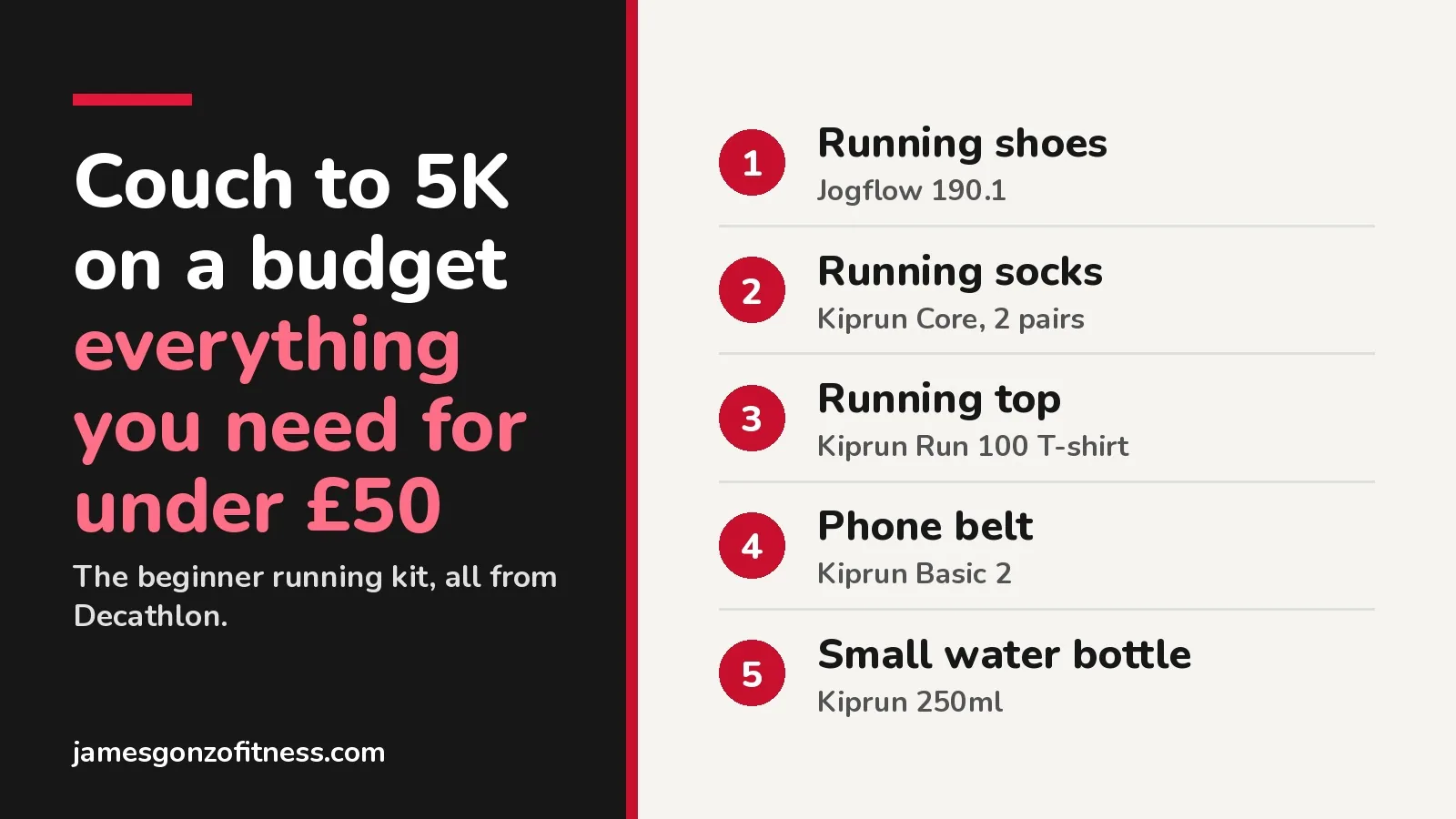
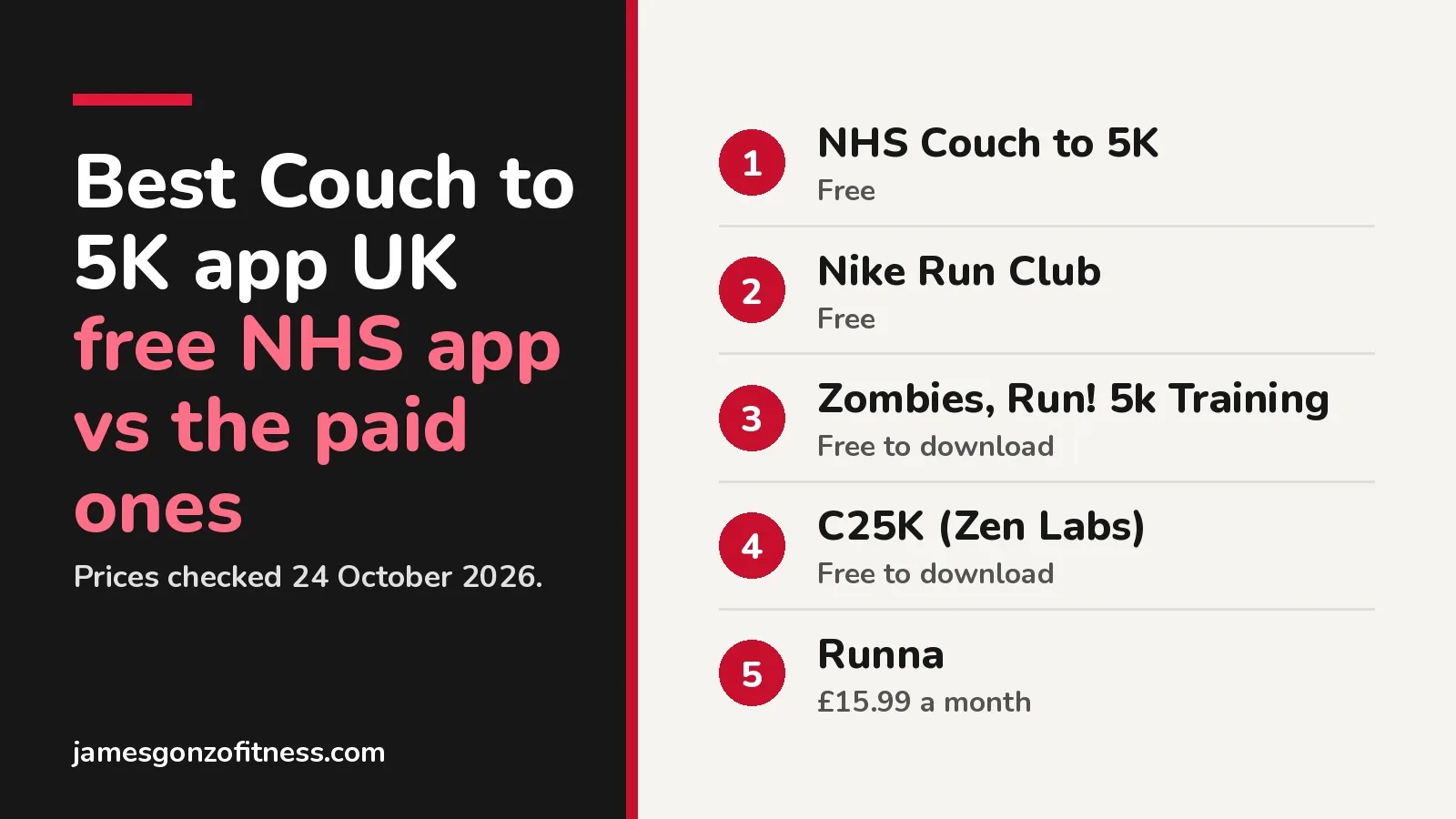
My Couch to 5K on a budget post has the rest of the kit, and my best Couch to 5K app post helps you pick how to follow the plan.
How to choose your first pair: the 5-point check
1. Comfort comes first
You'll hear confident claims about impact, arches and "pronation", which is how your foot rolls in as it lands. The research is less certain than the shop shelves make out. A 2015 paper in the British Journal of Sports Medicine (Nigg and colleagues) argued that the old reasons for choosing shoes weren't well supported, and suggested a "comfort filter": choose the shoe that feels comfortable to you. The authors said this idea needed more testing.
A 2022 review (Agresta and colleagues, in Frontiers in Sports and Active Living) found the evidence behind any shoe-choosing method is limited. Its practical suggestion was a shoe that is lightweight, comfortable and has minimal pronation-control technology. So choose the shoe that feels best on your foot, not the one with the longest list of features.
2. Fit matters
World Athletics says the further you run, the more your foot naturally expands, so it's wise to have a little extra room in the shoe. It also says width matters as much as length, because people often have wider or narrower feet than the "norm".
Sports Direct suggests taking your running socks when you try shoes on. It also says not to buy a pair without trying them on, or at least to keep your receipt so you can return them if they don't fit.
3. Neutral or stability?
A podiatrist quoted by World Athletics says stability shoes are for runners who over-pronate. The Agresta review, though, suggests minimal pronation-control technology. So the sources don't fully agree. If you have an old injury, or a physio or podiatrist has told you which kind of shoe you need, follow their advice. If you're not sure, talk to your GP or a physio.
4. Is gait analysis worth it?
Gait analysis looks at how you move. Sports Direct says its bigger stores have one, and the World Athletics podiatrist says he'd always recommend one before buying. Dr Whyte says beginners should go to a dedicated running shop and ask someone who knows.
The evidence for matching shoes to foot type is limited, though. A running shop is still useful because you can try several pairs, but it's not a reason to put off starting.
5. Road or trail?
Pavements, parks and treadmills are all "road" running. Sports Direct says to look for cushioning, a smooth but sturdy sole and lightweight breathability. Trail shoes have stronger soles with more traction for fields and forest paths. Every shoe below is a road shoe.
The 3 best beginner running shoes under £80
Prices checked on 31 October 2026. Prices and stock change, and these sale prices are for the colours and sizes listed, so check the shop before you buy. There are no affiliate links in this post.
1. ASICS Gel-Contend 9 (ASICS Outlet UK): £32, was £65
- Best for: an all-round first shoe from a big running brand.
- Spec: ASICS lists GEL technology and AMPLIFOAM+ cushioning in the midsole, a neutral shoe for road running, 274g and an 8mm heel drop.
- What Runner's World UK says: it gave an earlier version, the Contend 5, its best value shoe award in 2020, calling it "a perfect all-rounder for new or lower mileage runners". That was the Contend 5, not this one.
- The catch: some Runner's World UK testers found the Contend 5's toe box a little slim, so check the width. It's an outlet price, so sizes can run out.
2. ASICS Gel-Excite 10 (ASICS Outlet UK): £44, was £80
- Best for: anyone who wants a softer feel underfoot.
- Spec: ASICS says it's much lighter than the last version, with AMPLIFOAM PLUS in the midsole and a higher stack height for more cushioning. It lists 260g and an 8mm heel drop.
- The catch: I couldn't find a review I can quote, so judge it by how it feels. Outlet stock can change.
3. Jogflow 190.1 (Decathlon UK): £24.99, was £29.99
- Best for: the tightest budget.
- Spec: Decathlon says it gives soft shock absorption for runs of up to 20km a week, and shows 4.6 out of 5 from over 9,800 customer reviews.
- The catch: it's built for lighter weekly mileage. If you're heading beyond 20km a week, look at something with more cushioning.
Quick comparison
| Shoe | Price checked on 31 October 2026 | Shop | Best for |
|---|---|---|---|
| ASICS Gel-Contend 9 | £32 (was £65) | ASICS Outlet UK | An all-round first shoe |
| ASICS Gel-Excite 10 | £44 (was £80) | ASICS Outlet UK | A softer, more cushioned feel |
| Jogflow 190.1 | £24.99 (was £29.99) | Decathlon UK | The tightest budget |
My kit page lists the rest of the kit I recommend.
When is it worth spending more?
Once Couch to 5K is done and you know you're sticking with it, spending more can make sense, as Dr Whyte says. The same goes if you're training for a longer distance, or a shoe just doesn't feel right.
Pricier shoes can be lovely, but you don't need them for week 1.
Thinking longer? My beginner half marathon plan covers what comes next.
Mistakes beginners make with running shoes
- Buying on looks. Sports Direct says it's comfort over style, every time.
- Buying without trying them on. If you order online, check the returns policy first.
- Getting a size too small. World Athletics says to leave a little extra room.
- Running a long run in brand-new shoes. Wear them on a short walk or easy run first. That's my tip, not a rule from a study.
- Keeping worn-out shoes going. See below.
How long do running shoes last?
World Athletics says runners are generally advised to replace their shoes every 500 to 800km (300 to 500 miles), and that heavier runners will probably need to replace them more often.
Here's a simple example: at 15km a week, 500km would take about 33 weeks. Your own mileage and weight will change that, so watch for wear too. If your feet, knees or shins start to hurt, talk to your GP or a physio.
Quick questions
Do I need expensive running shoes for Couch to 5K?
No. Dr Greg Whyte says you don't need "very good trainers" to start, because much of Couch to 5K is walking at first. Choose comfortable, supportive running shoes that fit well.
Do I really need proper running shoes as a beginner?
The NHS says to wear running shoes that support your feet. They don't need to cost much, as the picks above show.
Is gait analysis worth it?
Some experts recommend it, and it's handy for trying several pairs. The research on matching shoes to foot type is limited, so it isn't essential.
Neutral or stability shoes for beginners?
The sources don't fully agree. If a physio or podiatrist has told you what you need, follow that. If you're unsure, talk to your GP or a physio.
How should running shoes fit?
With a little extra room in the shoe, because your foot expands the further you run, and with enough width (World Athletics). Try them with your running socks (Sports Direct).
Can I run in gym trainers or fashion trainers?
The NHS says to wear running shoes that support your feet, so start there. If anything hurts, talk to your GP or a physio.
How soon should a beginner get new shoes?
World Athletics suggests every 500 to 800km, which is a long way for a beginner. Check for wear now and then.
Are Decathlon running shoes any good?
Runner's World UK has tested Decathlon's own Kalenji and Kiprun running shoes, and the Jogflow 190.1 above is the Decathlon pick here. Try them on and check the returns policy, as with any pair.
Shoes sorted? Now get the plan
Grab my free 7-day kickstart plan and get going. If you're coming back after a break, try Fit Again in 6 Weeks. My printable Couch to 5K plan is free too.
What's the one bit of running kit you wouldn't go without?
Cheers,
James 👍