I'm James Gonzo, a beginner-friendly PT in Heywood. If you've just bought a kettlebell, or you're about to, here's the short version. Learn six moves: the deadlift, goblet squat, single-arm row, overhead press, carry and two-hand swing. Do them two or three times a week. And start with one bell, often around 8kg for women and 12kg for men, as a starting point rather than a rule.
One kettlebell in the corner of the living room is enough to get properly stronger at home. The NHS wants adults doing strength work on at least two days a week, and this is one of the easiest ways to tick that off.
Why a kettlebell is a good first bit of kit
The NHS physical activity guidelines say adults should do strengthening activities that work all the major muscle groups, legs, hips, back, abdomen, chest, shoulders and arms, on at least 2 days a week. One kettlebell covers all of that.
The NHS page on improving strength keeps the numbers simple: 8 to 12 repetitions of each exercise counts as one set, do at least 2 sets (3 for more benefit), and build up gradually over a period of weeks.
It doesn't take much room either, and you don't need a gym. The research backs it up without making it magic. A 2024 randomised trial in obese young men found 12 weeks of kettlebell training reduced body fat significantly, with results broadly similar to bodyweight training (BMC Sports Science, Medicine and Rehabilitation, 2024). It's a good tool, not a shortcut.
What weight kettlebell should a beginner buy?
These are common coaching starting points from kettlebellsworkouts.com, not hard rules:
| Who you are | Starting weight | Why |
|---|---|---|
| New to lifting, most women | 8kg | Enough to learn deadlifts and goblet squats properly |
| New to lifting, most men | 12kg | A sensible first bell for the basic moves |
| Some strength training already | One step up (12kg or 16kg) | Your legs and hips can handle more |
| Older, or coming back after injury | Start lighter | Get the technique right first, then build |
Your legs and hips can handle much more than your shoulders, so a weight that suits deadlifts may be too heavy to press. Cleveland Clinic makes the same point: different movements may need different weights. One bell is fine to start. A second, heavier one for legs and swings is a good later buy.
When it's time to go up, The Physical Company suggests jumps of 2kg to 4kg. My rule: pick the lightest bell you can move with good form, not the heaviest you can heave up.
Cast iron, rubber-based or soft?
Cast iron with a flat base is the classic and does everything. A rubber base is kinder to floors. Soft, sand-filled kettlebells are floor-friendly but aren't great for swings. Decathlon and Argos both stock beginner kettlebells, so check today's prices there before you buy.
Before you start: three safety basics
- Check in with your GP if you haven't exercised for a while or have a health condition. The NHS guidelines say the same.
- Clear some space. Cleveland Clinic suggests a non-slip surface like a yoga mat, and testing your form before adding weight. Make sure no one is walking behind you.
- Stop if it hurts. Cleveland Clinic puts it simply: exercise should challenge you, not hurt you. Achy muscles a day or two later are normal. Sharp or joint pain isn't, so stop and get it checked.
The 6 kettlebell exercises to learn first
Learn them in this order. The swing goes last on purpose, because it needs the deadlift to be solid first. Sets and reps follow the beginner plan from LiftStrong.
1. Kettlebell deadlift
Works your glutes, hamstrings, back and grip, and teaches the hip hinge that everything else builds on.
- Stand with the bell between your feet.
- Push your hips back, keep your back flat and grab the handle with both hands.
- Drive your feet into the floor to stand up tall, and squeeze your glutes at the top.
- Common mistake: squatting it. Your hips go back, not down.
- Start with: 3 sets of 8 to 10.
2. Goblet squat
Works your thighs, glutes and core.
- Hold the bell by the horns at your chest.
- Sit down between your legs with your elbows inside your knees.
- Stand tall at the top.
- Start with: 3 sets of 8 to 10.
3. Single-arm row
Works your upper back and arms.
- Hinge forward about 45 degrees, bell in one hand.
- Pull it up to your hip and squeeze your shoulder blade.
- Lower with control.
- Start with: 3 sets of 8 to 10 each side.
4. Overhead press
Works your shoulders, arms and core. Go lighter here.
- Bring the bell up so it rests on your forearm, elbow tucked in.
- Press it straight up and lower it with control.
- Start with: 3 sets of 6 to 8 each side.
5. Suitcase carry
Works your grip, core and posture.
- Hold the bell at your side and walk slowly.
- Stay tall and don't lean towards the bell.
- Start with: 3 rounds of 30 seconds each side.
6. Two-hand swing
Works your glutes, hamstrings and back, and gets your heart going.
- Hike the bell back between your legs, then snap your hips forward.
- Your arms just hold on. The bell should reach about chest height, no higher.
- Squeeze your glutes at the top.
- Common mistake: turning it into a squat or a front raise. It's a hip hinge.
- Start with: 5 sets of 10, only once your deadlift feels solid.
Feeling swings in your lower back?
This is the worry I hear most from beginners. You should mostly feel a swing in your glutes and hamstrings. If it's your lower back, the usual causes are squatting the swing instead of hinging, rounding your back, lifting with your arms, or doing too many reps too soon. LiftStrong puts it bluntly: watching one video and jumping straight into swings with poor form is how people hurt their backs.
The fix is simple. Go back to deadlifts for a week, use a lighter bell and do fewer reps. If the pain carries on, stop swinging and get it looked at by your GP or a physio.
A simple 20-minute beginner workout
Warm-up (3 to 5 minutes): march on the spot, a few bodyweight squats and some hip hinges.
Circuit:
- Deadlift x 10
- Goblet squat x 8
- Single-arm row x 8 each side
- Overhead press x 6 each side
- Suitcase carry, 30 seconds each side
Rest 60 to 90 seconds and repeat for 2 to 3 rounds. That lines up with the NHS's 2 to 3 sets.
Your first 4 weeks
| Week | What to do | Sessions |
|---|---|---|
| 1 | Learn the deadlift, goblet squat and row | 2 |
| 2 | Add the press and carry | 2 |
| 3 | Add swings, low reps | 2 to 3 |
| 4 | The full workout | 3 |
Cleveland Clinic suggests two to three sessions a week, and I'd keep a rest day between them. Add reps before you add weight, and only move up a bell when the last reps feel smooth.
Kettlebells, weight loss and running
Can kettlebells help with weight loss? They can play a part. Strength work helps you hold on to muscle, and the 2024 trial above saw body fat drop. But what you eat and how much you move each day matter most. The NHS also lists strength work separately from the 150 minutes of moderate activity a week it recommends, so pair your kettlebell sessions with walking or running. If you want a simple place to start, my free 7-day kickstart plan is a good first step.
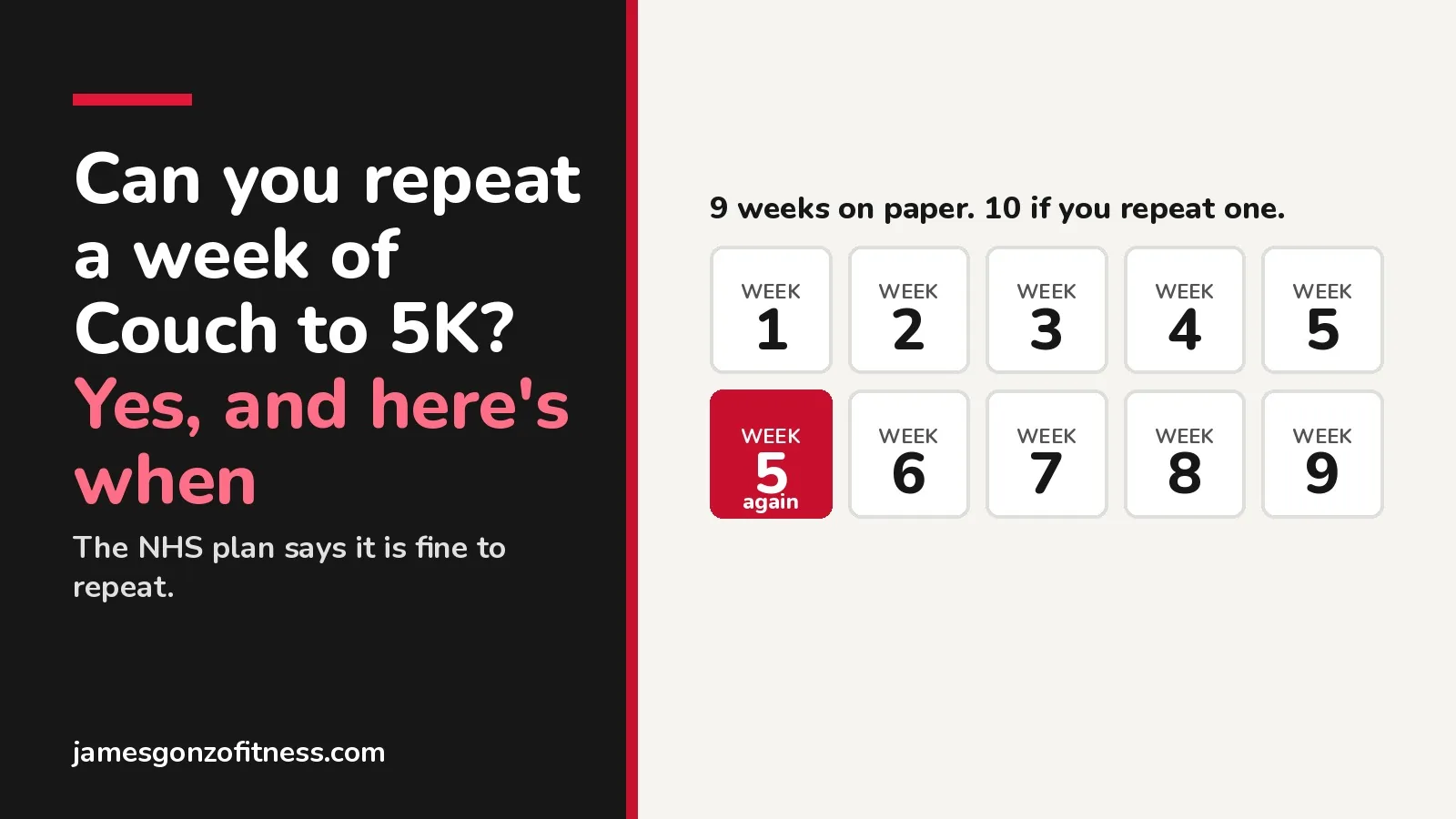
Kettlebells and running go well together too. Two short sessions a week alongside Couch to 5K or parkrun build stronger hips and legs. If you'd rather start without kit, try my Couch to 5K strength plan. If you've got a gym, read gym muscular endurance for runners, and there's more on my running page.
Quick questions
What weight kettlebell should a beginner start with?
A common starting point is 8kg for most women and 12kg for most men. Go lighter for presses, and lighter again if you're older or coming back from injury.
Is one kettlebell enough?
Yes, to start. Later on, a second, heavier bell is handy for legs and swings.
How often should beginners use a kettlebell?
Two or three times a week with a rest day in between. The NHS asks for strength work on at least 2 days a week.
Can you build muscle with just a kettlebell?
Yes, especially as a beginner, as long as you keep adding reps or weight over time.
Are kettlebell swings bad for your back?
Not when they're done as a hip hinge with a sensible weight. Lower back ache usually means technique or too much too soon. If pain carries on, see your GP or a physio.
Can I do kettlebell workouts at home?
Yes. You need a bit of clear space and a non-slip floor or mat. A rubber base helps protect floors.
Sources: NHS physical activity guidelines for adults; NHS: how to improve strength; Cleveland Clinic; kettlebellsworkouts.com; The Physical Company; LiftStrong; BMC Sports Science, Medicine and Rehabilitation, 2024. All checked on 25 October 2026.
Want a simple plan to follow?
You don't need a full gym to get stronger. One kettlebell, six moves and two or three short sessions a week will take you a long way.
If you'd like something to follow, grab my free 7-day kickstart plan. If you want six weeks mapped out for you, have a look at Fit Again in 6 Weeks. The rest of my beginner kit is on my kit page.
What's the first move you're going to try?
Cheers,
James 👍