If week 4 of Couch to 5K feels hard, you're not doing it wrong. The runs just got longer.
I'm James Gonzo, a beginner-friendly coach in Heywood. This post sets out the official NHS Couch to 5K week 4 sessions, quoted from the NHS plan, why they feel like a step up from week 3, and what to do if you need to repeat the week. After that, week 5 is next, including your first 20-minute run.
This isn't medical advice, and it isn't an NHS endorsement of my coaching. If you have a health condition, haven't exercised for a while or are worried about your health, speak to a GP before you start or carry on. The NHS says the same about Couch to 5K.
What week 4 of Couch to 5K actually asks of you
Here's the NHS Couch to 5K plan for week 4, quoted from the official running-plan page. I haven't changed the timings. Every run starts with a stretch and a 5-minute warm-up walk, and ends with a 5-minute cool-down walk and a stretch. The NHS total time for each run is 31 minutes and 30 seconds, excluding stretches.
The NHS intro to the week is:
Great job making it to week 4! This week, the runs are getting a little longer. It might feel challenging, but that's all part of building your strength and stamina. Don't forget to take a rest day between each run. Rest days give your body time to recover and get stronger. As the runs get longer, focus on keeping your breathing steady. Try to match your breath to your stride: inhale for 3 steps, then exhale for 2. Stay relaxed and take it at your own pace, and remember, you've got this!
All three runs use the same session:
- Stretch: Before run
- Warm-up: 5 minute walk
- Run: 3 minutes
- Walk: 1 minute 30 seconds
- Run: 5 minutes
- Walk: 2 minutes 30 seconds
- Run: 3 minutes
- Walk: 1 minute 30 seconds
- Final run: 5 minutes
- Cool-down: 5 minute walk
- Stretch: After run
The NHS notes on each run, quoted:
- Run 1: "Another slight increase since your last run, but remember, stay at a pace that feels good, and keep building on your progress. You're doing amazing!"
- Run 2: "You've done this same run before, so it should feel a bit easier now. Go at your own pace and keep building on your progress."
- Run 3: "You're getting into the rhythm now! Run 3 is the same as the other runs this week, so it should feel more familiar. Remember to keep good posture on your run. Keep your head up, your back straight, and relax your shoulders."
If you want a printable copy of the whole plan, use my printable Couch to 5K plan.
Why week 4 feels so hard
Look at where you've come from. In week 3 of the NHS plan, each run has a total time of 25 minutes, excluding stretches, and the longest single run is 3 minutes.
In week 4 the total time is 31 minutes and 30 seconds, and you run for 5 minutes twice in the same session, with 3-minute runs in between. The walks are still there, but the running blocks are longer than anything in week 3.
So when week 4 feels like a jump, that's why. The NHS already flags it: the runs are getting a little longer, and it might feel challenging.
In my view the other part is pace. In the shorter week 3 intervals you can get away with running a bit too fast, because a walk break is coming sooner. In a 5-minute run that catches up with you. Slow down. If you can't say a short sentence out loud, you're going too fast. The NHS week 4 note says to stay at a pace that feels good. Later in the plan, in week 5, it also says it's not about speed, it's about building stamina.
How to get through week 4
Take the rest day. The NHS says, in week 4 itself, not to forget a rest day between each run, because rest days give your body time to recover and get stronger. Don't squeeze three runs into three days to "get it over with".
Use the NHS breathing cue: "match your breath to your stride: inhale for 3 steps, then exhale for 2." It gives your mind something to do other than watch the clock.
Keep good posture on run 3, as the NHS says: head up, back straight, shoulders relaxed.
Stay relaxed and take it at your own pace. That's the NHS wording, and it still applies if run 1 felt messy. Run 2 and run 3 are the same session, and the NHS says that repetition should help it feel more familiar.
You can do week 4 on a treadmill if that's where you train. I've written about Couch to 5K on a treadmill.
What if you can't finish it?
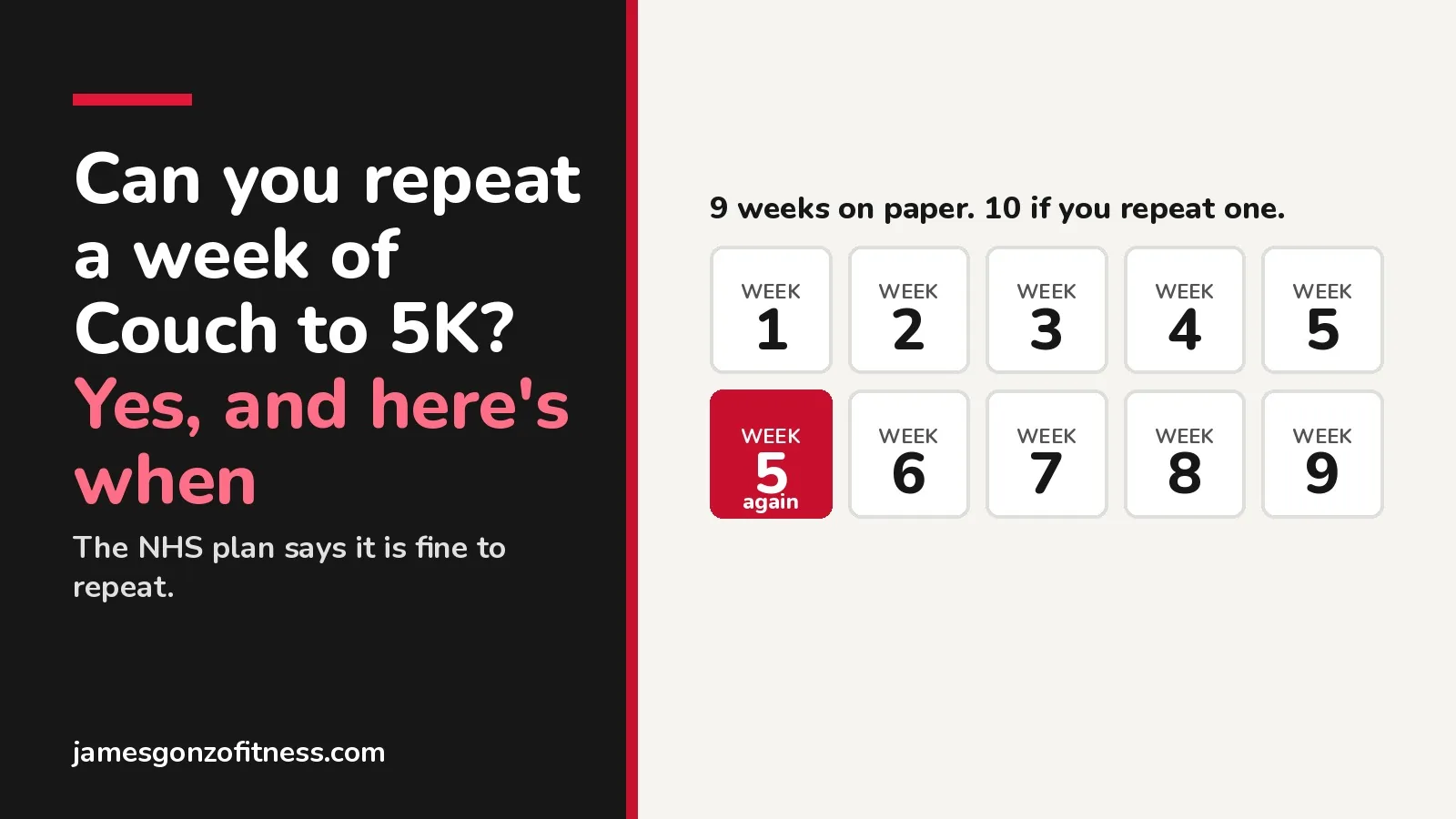
Then you repeat it. The NHS Get running page says you can complete the programme in 9 weeks or longer, depending on what works best for you. The week 5 page of the official plan also says that if you need to repeat any of the runs or weeks, that's totally okay.
Nobody is timing you, and there's no prize for finishing in exactly 9 weeks.
If you had to stop and walk during a 5-minute run, try one of these next time:
- Do the same session again on your next run day, slower.
- Repeat the whole of week 4 before you move on.
- If week 3 already felt like a struggle, repeat week 3 once more, then come back to week 4.
I've written a whole post on when to repeat a week of Couch to 5K, and how to do it without feeling like you've gone backwards.
Feeling challenged is normal. The NHS says so as the runs get longer. If something doesn't feel right, stop, and speak to a GP if you're worried about your health.
What comes after week 4
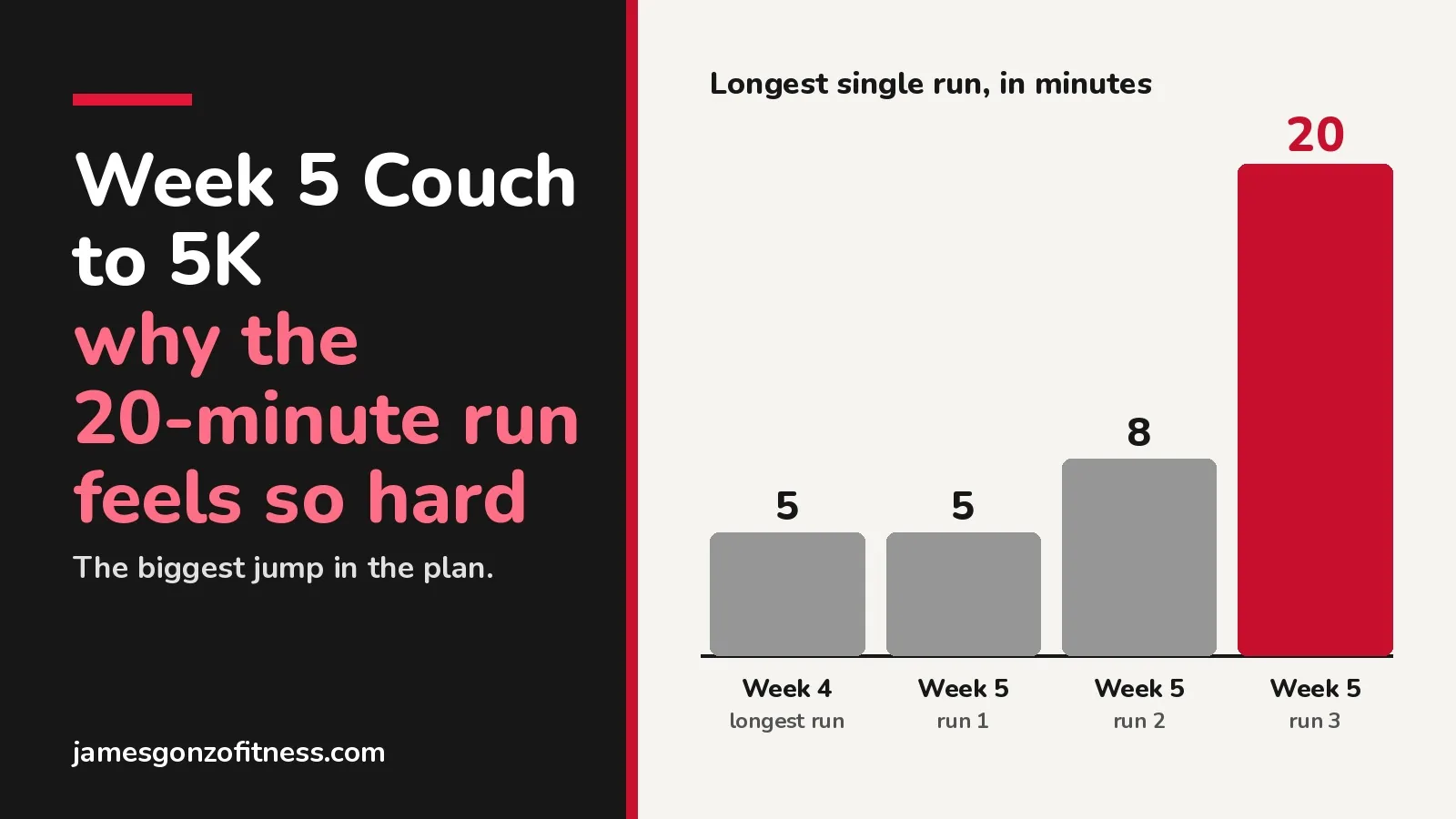
Week 5. In the official NHS plan, week 5 run 1 is three 5-minute runs with 3-minute walks, run 2 is two 8-minute runs with a 5-minute walk, and run 3 is a 20-minute run with no walking, still with the 5-minute warm-up and cool-down walks. I've already written the next post: Week 5 Couch to 5K: Why the 20-Minute Run Feels Hard.
That's why I wouldn't rush week 4. The longest run this week is 5 minutes. Week 5 run 3 asks for 20.
A Couch to 5K strength plan sits alongside the running if you want something to do on rest days.
Staying safe
- Speak to a GP first if you're worried about your health, if you have a health condition, or if you haven't exercised for a while.
- Warm up and cool down. Every NHS week 4 run starts with a 5-minute warm-up walk and ends with a 5-minute cool-down walk. The NHS knee-pain advice is 5 to 10 minutes of brisk walking or gentle jogging before you start, and a gradual cool-down after.
- Always listen to your body, take things at your own pace, and stop if something doesn't feel right. That's the NHS wording on the plan page.
- If you get chest pain, stop. The NHS says to call 999 if you get sudden chest pain or discomfort that doesn't go away, chest pain that spreads to your arm, neck, jaw, stomach or back, or chest pain with sweating, feeling sick, light-headedness or shortness of breath. If chest pain comes and goes, or goes away quickly but you're still worried, see a GP.
- If you get knee pain that is severe, or the knee is swollen, the NHS says to see a GP straight away. If the pain is not severe, stop running and get it checked by a GP or physiotherapist if it does not go away after a week.
- Keep a rest day between running days.
This is general information, not a diagnosis or a training prescription for an injury.
Questions
What if Couch to 5K week 4 feels too hard?
Slow down, keep the rest day, and repeat the session or the week if you need to. The NHS says you can take longer than 9 weeks, and that repeating a run or a week is okay. I've written more in my repeat a week post.
Does week 4 of Couch to 5K have a set distance?
No. The official NHS sessions for week 4 are timed in minutes, not set to a number of kilometres or miles. I haven't given a distance because the NHS doesn't.
What comes after week 4?
Week 5 of the official NHS plan, which builds to a 20-minute run. I cover that in Week 5 Couch to 5K: Why the 20-Minute Run Feels Hard.
Sources, all read on 10 November 2026: NHS Couch to 5K running plan (week 3, 4 and 5 sessions); NHS, Get running with Couch to 5K; NHS physical activity guidelines for adults aged 19 to 64; NHS, Knee pain and other running injuries; NHS, Chest pain.
Want a hand?
If you want a coach to look at your week 4, I offer running coaching in Heywood.
Cheers,
James