I'm James Gonzo, a beginner-friendly coach in Heywood. If you're an adult who never learned to swim and you're wondering whether that ship has sailed, the short answer is no. Swim England says no one should feel it's too late for them to learn, at any age or ability level. This post covers how common it is, what adult lessons are like, and how to take the first step.
The short answer
You're not too old. Swim England's Adult Swimming Framework is for people aged 16 and over, with four progressive stages, and it says there's no age limit. It's built for complete beginners right up to experienced swimmers who want help with technique.
Swim England says adults have different needs from children when it comes to learning to swim. As an adult you have different motivations and you learn in different ways. So adult lessons are designed for adults.
How many adults can't swim?
More than you'd think. In October 2019, Swim England reported that 14.2 million adults in England, or 31 per cent, couldn't swim one length of a 25m pool. It uses a similar figure on its adult framework page: around 30% of UK adults can't swim a length, and one quarter of adult non-swimmers would like to learn.
It's also common to feel nervous about it. Swim England research published in March 2023 found that more than half of adults feel it's intimidating to learn to swim. That rose to nearly three in five among people who had never swum. Men were more likely to feel embarrassed about lessons.
Swim England says some common beliefs are simply wrong. Adult beginners don't have to wear armbands. They don't have to wear a conventional costume. And lessons aren't only for children or complete beginners.
One of the swimmers in that campaign, Jamal Hussan, had his first ever lesson at 45. He said age and body shape can play a role in why people avoid lessons, but that shouldn't get in the way of anyone starting.
What are adult beginner lessons like?
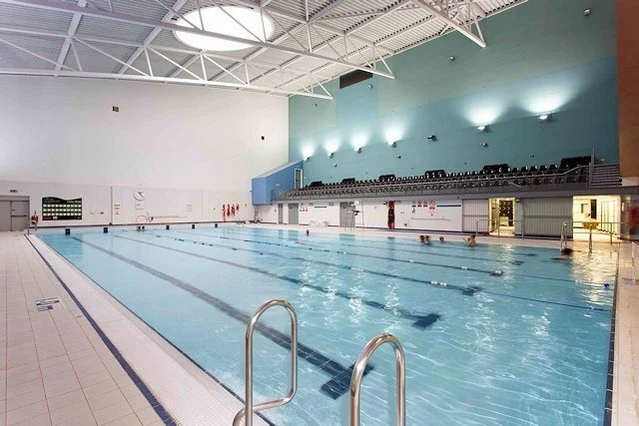
Swim England's London region says most adult beginner lessons take place in a shallow pool, anywhere between 0.9m and 1.2m deep, with a low ratio of teachers to students. I can't promise your local pool follows that to the letter, so ask them how their adult sessions work.
It also says to expect a course rather than a single lesson. In its words, it's not a skill that can be taught overnight. It recommends a course of lessons that runs for 8 to 12 weeks, and says that if you can get to the pool to practise between lessons, you'll progress much quicker.
Its practical tips are simple:
- Take a towel, a swimming cap, goggles and a comfortable, secure swimsuit.
- Progress depends largely on how committed you are, so a course beats the odd drop-in.
- You will be able to float. Swim England says our bodies are about 70% water and have a similar density to water, so there's an upward force helping you float.
Fear is the main reason adults give for never learning, according to Swim England, and it says learning to swim need not be a fearful adventure. If you're nervous, say so to your teacher before you start.
Do I need to check with my GP first?
It depends on you. The NHS physical activity guidelines for adults say to speak to your GP first if you haven't exercised for some time, or if you have medical conditions or concerns. They also say to make sure your activity and its intensity are appropriate for your fitness.
The same NHS page lists swimming as an example of vigorous intensity activity, meaning it makes you breathe hard and fast. It also says adults should aim for at least 150 minutes of moderate activity, or 75 minutes of vigorous activity, a week. You don't need to be anywhere near that on day one. Moving Medicine says you don't have to swim far to benefit. It suggests that just being in the water can help, and that walking through the shallow end or gently moving your arms and legs is a start.
If you have a heart or lung condition, joint problems, or you're not sure, talk to your GP before your first session. I'm a coach, not a medical professional, so I won't advise on that.
How to get started
- Find adult beginner sessions near you. Swim England says more than 1,000 leisure centres and swim schools in the UK run its Adult Learn to Swim lessons. Phone or look at your local pool's timetable and ask for adult beginner lessons.
- Ask for a chat first. You can ask what the group size is, how deep the water is and what the first session covers. That takes away a lot of the fear of the unknown.
- Sign up for a course, not one session. Swim England's guide is 8 to 12 weeks. Lessons that run week after week give you a base to build on.
- Practise in between if you can. Swim England says that getting to the pool to practise between lessons makes your progress much quicker.
- Check the basics. Ask your teacher about their experience and whether the pool has a lifeguard on duty.
- Be patient. There's no prize for being fast. Progress might be floating, then moving a few metres, then more.
Swimming also opens doors. Swim England's London region mentions seaside holidays, sailing, snorkelling and some professions. Once you can swim, you could even join a Masters club.
What a free resource can and can't do
I run a free swimming exercises page on this site with pool drills and a four-week plan. It's there to help once you're in the water and want something to practise between sessions. Some of it will suit you better after you've had a few lessons. If you're a complete beginner, a teacher in the pool beats any page.
If you'd like help from me, I'm opening one-to-one adult swimming coaching in Heywood from January 2027. It starts with a conversation about where you are now and what you'd like to be able to do, and there's a free waiting list. Places are limited.
Quick questions
Am I too old to learn to swim?
No. Swim England says no one should feel it's too late to learn, at any age or ability level. Its Adult Swimming Framework is for people aged 16 and over and has no age limit.
Can I learn if I'm scared of the water?
Yes. Swim England says fear is the main reason adults never learn, and that learning needn't be fearful. Tell your teacher you're nervous before you start so they can go at your pace.
How long does it take to learn to swim as an adult?
It varies from person to person. Swim England says it can't be taught overnight and recommends a course of 8 to 12 weeks. How quickly you progress depends largely on your commitment and how often you can practise.
Do adult beginners have to wear armbands?
No. Swim England lists that as a common myth, along with the idea that you must wear a conventional costume.
Should I see my GP before I start swimming?
The NHS says to speak to your GP first if you haven't exercised for some time, or if you have medical conditions or concerns. If that's you, ask before your first lesson.
Sources: Swim England (Adult Swimming Framework, adult learn to swim campaign, March 2023, adults who can't swim, October 2019, London region learn to swim guide); NHS physical activity guidelines for adults; Moving Medicine: pool swimming. All checked on 25 October 2026.
Thinking about learning to swim?
Try my free swimming exercises page for pool drills and a four-week plan, or join the free waiting list for adult swimming lessons in Heywood.
What's the one thing you'd love to be able to do in the water? Tell me, and I'll do my best to point you in the right direction.
Cheers,
James 👍